Blood Sugar Without Obsession
How to eat for stable glucose without tracking, counting, or making food complicated

There’s a version of yourself you might recognize from certain days. You wake up and feel actually rested. You eat breakfast, and it holds you, no reaching for something else an hour later. Your energy throughout the morning is even, not spiking and crashing. You make it to lunch without being ravenous. The afternoon doesn’t flatten you. You’re not thinking about food constantly. You feel regulated.
That’s what stable blood sugar feels like, and most women have felt it at some point, usually without knowing that’s what it was. And most women have also felt the opposite: the mid-morning crash, the 3pm fog, the pre-dinner irritability, the evening where you eat everything in the kitchen even though you weren’t particularly hungry at dinner. That’s unstable blood sugar. And once you understand the mechanisms behind both states, you realize that getting from one to the other isn’t about tracking anything. It’s about a handful of habits that change the entire shape of your day.
Why blood sugar stability matters more than the number
Blood glucose monitoring has become trendy in wellness spaces, and the CGM (continuous glucose monitor) conversation has created the impression that the goal is to keep your glucose as flat as possible at all times. This is an overcorrection!
Some glucose variability is normal. Eating raises blood sugar, and that’s the point. The question is not whether it rises but how high, how fast, and how long it takes to come back down. A moderate rise followed by a smooth return to baseline is a healthy glucose response. A sharp spike followed by a rapid crash is the pattern that creates fatigue, cravings, brain fog, and the afternoon when you’d do anything for something sweet.
Green Line: Healthy / Red Line: Unhealthy
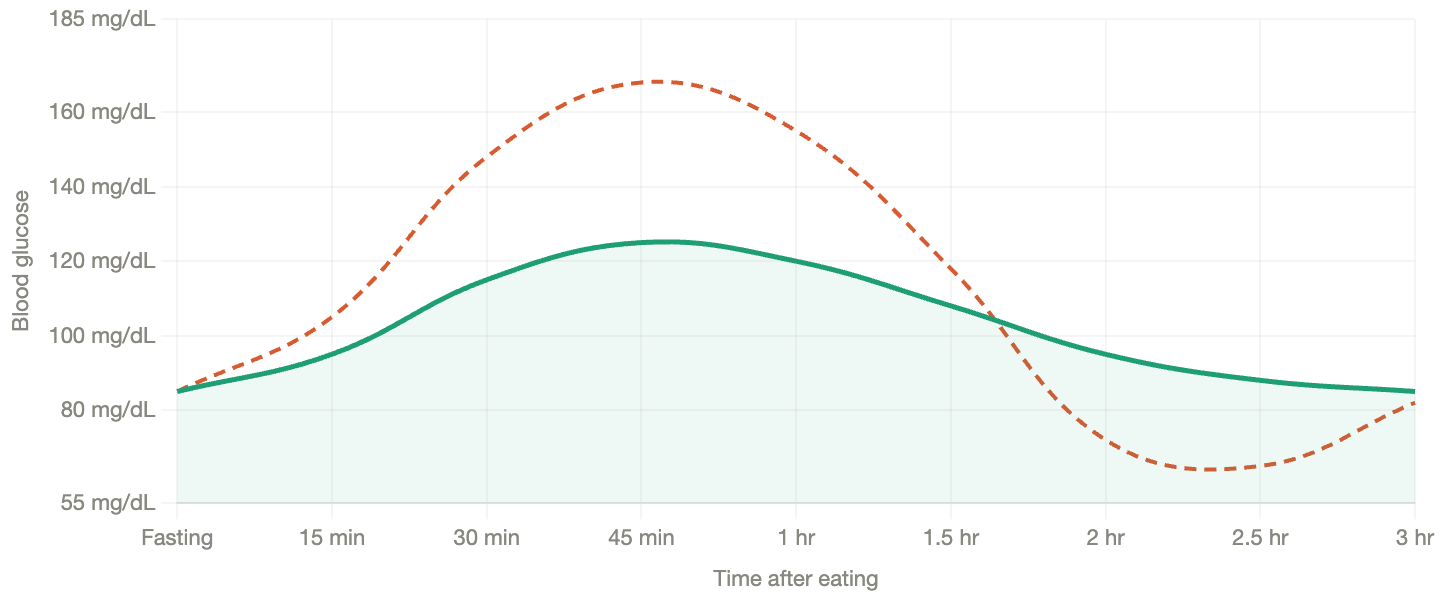
The difference between those two patterns is almost entirely determined by what you eat, in what order, with what else, and when you move.
